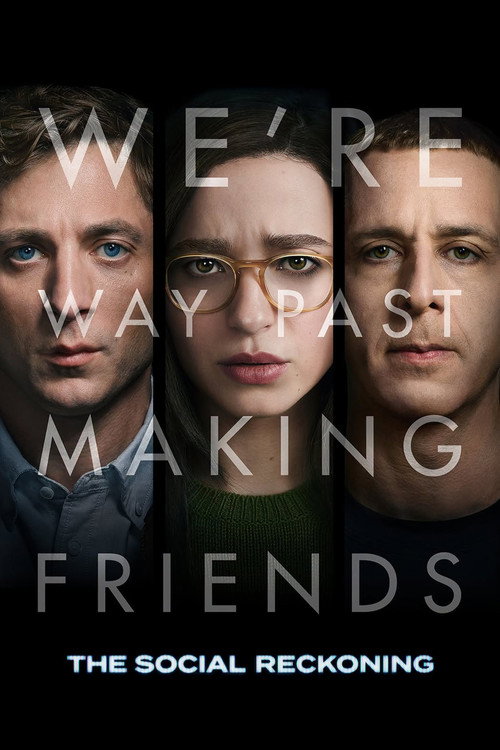
The Social Reckoning Review: Sharp Dialogue, Little Connection
Going into The Social Reckoning expecting another The Social Network is probably the quickest way to leave disappointed. There are strong performances here, and Aaron Sorkin certainly hasn’t forgotten how to write dialogue. But the atmosphere, visual storytelling and emotional investment feel a long way removed from what you might expect from a follow-up. It’s a perfectly watchable film. I just kept waiting for it to become something more.
Written and directed by Sorkin, this companion piece shifts its attention toward Facebook whistleblower Frances Haugen, played by Mikey Madison, and The Wall Street Journal reporter Jeff Horwitz, played by Jeremy Allen White. Their story forms the basis of a dramatized account of the events behind the newspaper’s 2021 investigation, The Facebook Files, which drew on internal company documents supplied by Haugen. Rather than continuing directly from Facebook’s beginnings, the film examines the consequences of what it became.
On paper, I understand that choice. In practice, I’m still not convinced this was the most compelling direction for a follow-up. I would have been much more interested in picking up a few years after the first film and exploring how Facebook grew into such an enormous force. There’s a whole stretch of that evolution I wanted to see, and jumping ahead to this investigation left me feeling as though we had skipped over the story I was actually interested in.
Instead, we get something closer to a political and journalistic drama. The film connects Facebook’s influence to wider social harms and the January 6 attack on the U.S. Capitol. The issue for me isn’t that it tackles those subjects or has a point of view. It’s that its argument often feels more developed than my connection to the people delivering it. I understood what the film wanted me to take away. I just didn’t feel particularly invested in the characters along the way. That distinction matters, because an important subject doesn’t automatically make an engaging film.
Where The Social Reckoning absolutely delivers is its dialogue. Sorkin’s writing has a rhythm and structure that make conversations worth listening to. There’s depth to the exchanges, and even the quicker remarks feel considered rather than thrown in for an easy laugh. These aren’t cheap one-liners pretending to be clever. At its best, the writing gives the actors something substantial to work with and makes the film engaging from one conversation to the next.
My frustration is that I continue to respond much more strongly to Sorkin as a writer than as a director. His command of language doesn’t always translate into equally compelling images. Here, the way scenes are staged and cut together often feels basic. The dialogue is doing most of the work, while the visuals rarely add enough to make those conversations feel especially cinematic.
The cinematography is by Jeff Cronenweth, who also shot The Social Network, but that returning credit doesn’t make the two films feel visually alike. What stood out to me here was the repeated use of extremely shallow depth of field. So often, the person speaking is sharp while practically everything behind them disappears into blur. Background performers and the spaces surrounding the characters become difficult to register.
There’s nothing inherently wrong with that technique. It can look fantastic in the right shot. But when it becomes such a dominant approach, it starts to feel repetitive rather than expressive. At times, it has an almost amateur quality, as though isolating a face against a blurry background is being treated as enough to make an image interesting. I’m not asking for blockbuster spectacle in a dialogue-driven drama. I just wanted more variety and more purpose in how those conversations were presented.
“The Social Reckoning has the dialogue to hold your attention, but too often feels more like a lecture than a story you’re emotionally invested in.” Thankfully, several performances give the film a considerable lift. Bill Burr is fantastic as Charlie, a Facebook employee. I’m much more accustomed to watching Burr in comedy, so his dramatic work here was one of the film’s best surprises. He feels completely comfortable with the material, and there’s a conviction to his performance that consistently caught my attention. More than anything, it made me want to see him take on more dramatic roles. He’s one of the clearest reasons to watch this film.
The other major standout is Succession’s Jeremy Strong as Mark Zuckerberg. His voice and mannerisms are spot on. There were moments when I genuinely felt that, had I closed my eyes, I could have believed I was listening to Zuckerberg himself. Strong captures the particular way he speaks and carries himself with remarkable precision. Whatever my issues with the film around him, this performance is not one of them.
Jeremy Allen White is also very good. His Horwitz feels believable, and the little quick-witted remarks scattered through his dialogue give the character some welcome personality. White handles those moments naturally without making them feel separate from the more serious material. He’s consistently engaging, even when the broader story isn’t giving me enough reason to care about where it’s heading.
Mikey Madison, on the other hand, left me wanting more. After how phenomenal she was in Anora, I found her performance here underwhelming by comparison. She’s believable as Haugen, and I wouldn’t call it bad acting, but some of her delivery has a slightly over-rehearsed quality. I could hear the lines being carefully delivered without always feeling the person behind them. It’s a performance I could accept rather than one I found myself drawn into.
To the film’s credit, pacing isn’t a major problem. Its approximately 112-minute running time moves along much faster than I expected. I wasn’t sitting there bored or waiting for it to end. The tone is consistent, the dialogue keeps things moving, and Alexandre Desplat’s score is another positive. There is enough here to hold your attention.
But holding my attention and making me care are two different things. I could enjoy an exchange, appreciate a performance and follow the investigation without feeling particularly attached to any of it. When it was over, there wasn’t a scene I kept returning to or a moment that really stayed with me. For a film with this much to say, it left a surprisingly faint impression.
Fans of Sorkin’s writing, true-event dramas or these actors will find things to enjoy, and there’s certainly enough strong work here to justify their interest. I’d happily revisit it on streaming. I just wouldn’t call it an essential cinema experience, especially for someone hoping to recapture the feeling of The Social Network.
Ultimately, The Social Reckoning isn’t a bad movie. It’s a passable one with excellent dialogue, a few fantastic performances and a story that never quite convinced me it was the right follow-up. It makes its point clearly. I just wish it had made me feel more along the way.